
As we grow into an increasingly digital world, trust is a critical human relationship that we must reopen with technology. As it continues to grow and wrap itself around more human needs and desires, we may be walking into an unconscious dependency that can erode values of safety, transparency, and even social cohesion and harmony. Instead, we must learn from instantiations of trust that bond people and societies together, produce positive values, and drive bonds based on conscious relationships with technology. Trust can then be leveraged to enhance the adoption of essential public goods and services, which is key to citizens’ enhanced quality of life.
Hence, with this report on Unbundling Women’s Digital Trust, we set out to consolidate two years of fieldwork, expert conversations, human-centered design analysis, and various other research activities to learn about existing and potential dynamics around digital trust in Indian societies, particularly within women’s technological experiences. Shortly after we began our investigation, we uncovered several gaps in the literature that brought us to the central challenges of doing this work.
Challenge
Description

Current discourse
is focused on digital access and usage, not trust
The ‘digital divide’ revolves around access and usage, missing key attitudes around digital adoption – how do we refocus attention on nuanced behaviours such as trust?
Disaggregated data on gendered experiences with trust is missing globally
Frameworks on digital trust tend to be gender-agnostic – how do we shape an approach that accounts for gender-centric variables especially in the Global South?
Trust is currently framed only as technological trustworthiness
Digital trust is analysed as only a product and business integrity goal – how can user experiences and behaviours be leveraged for a more human-influenced digital trust definition?
Cultural dynamics and vocabularies
are missing in the context of digital trust
Digital trust discourse is devoid of varying cultural contexts, particularly of the Global South territories - how do we move past a one-size-fits-all perspective?
Trust is largely assessed as an individual exercise
Trust flows relationally, and can be given collectively – how do we uncover the nuances between individual and collective trust production?
Why should we pursue a user-based trust inquiry for women?
Trust provides a deep and personal lens on large-scale technological impact – for women, it also helps uncover the ways that sociological inequality interacts in digital spaces. Additionally:
We gain a layered understanding of women’s digital security challenges, within digital and physical spaces For e.g. How does the presence of online harms intersect with gendered realities of physical access to devices?
We transform the adoption question to be guided by considerations of willingness, faith and other user-motivated behaviour, for a keen understanding of women’s meaningful digital usage beyond generic patterns
We actively focus on filling the human gaps in approaches of different trust and safety professionals, from private platforms to gov-tech, to civil society actors and others
We define and design digital trust with a more inclusive lens to create more robust public digital services that respond to women’s specific needs
How did we undertake this inquiry?
We use a mix of methodologies to achieve a holistic view of women’s digital trust.
[Conceptual Methodological Framework] Ontology of Digital Trust
Iterative trust-modelling tool that centralises the various determinants, elements, attitudes, and attributes found in technological conceptions as well as being psycho-socially relevant to the women in our sample, to guide our insights. This also stands as a research output. The ontology focuses on expanding our understand of three key dimensions of trust:The user’s agency in navigating digital platforms
The user’s decision-making around giving trust
The user’s interaction with the platform
Literature review
Deep dive into various sources around women’s digital trust, through a layered approach towards the following broad themes:Diversity in trust-definition frameworks
Developments in women’s increased engagements with technology, with a focus on India
Intersections between trust in the government and digital services
Indian policy landscaping around women’s welfare
Discussions of participatory research methods
Expert conversations
Interactions to uncover a diverse set of insights to shape trust questions, learn from existing knowledge, understand sectoral expertise in building trust, and enrich the definition of trust in our work.
We spoke to product professionals in digital platforms, user experience and interface designers, builders and thinkers in the digital public infrastructure space, developmental and skilling organisations that focus on gender impact, and professionals in the civil society and research space.
Participatory Vulnerability Analysis (PVA)
Primary fieldwork exercises to understand a wide range of societal perspectives and issues, focus-group discussions to test and understand the problem diagnosis at the community level and Key Informant Interviews to learn from perspectives of front-line workers and ground-level implementors of education, sanitation, healthcare and employment.
Human-Centered Design (HCD)
One-on-one interactions to understand personalised responses to trust-based digital situations, design sprints, and affinity mapping to consolidate analysis and persona mapping to understand wide expanse of trust-building journeys in Indian women.
What do our key insights look like?
One of the key objectives of this study has been to uncover the barriers, limiters, enablers, and drivers of women’s digital trust. We focus our inquiry on the decision-making dimension to unbundle these.
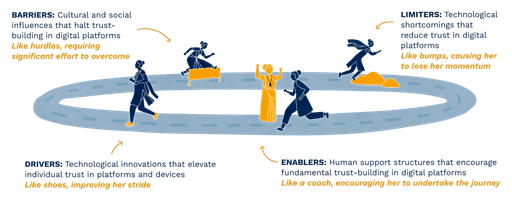
Drivers
User affinity-based products
Explorative features and avenues
Platform hyper-manoeuvrability
What are the outputs of this work?
We use a mix of methodologies to achieve a holistic view of women’s digital trust.
Ontology of Digital Trust
An iterative trust-modelling tool that centralises the various determinants, elements, attitudes, and attributes found in technological conceptions as well as being psycho-socially relevant to the women in our sample. This outcome provides a theoretical and practical tool to map trust behaviours in women (and is designed in a digital format on the Aapti website).Digital Trust Vulnerability Maps
A key understanding of the vulnerability types, mitigating and exacerbating factors that contribute to women’s trust-based digital harms and exclusions in the spaces of finance, health, education, recreation, and service delivery.Report
A full-length comprehensive report that examines women’s digital trust in India, analysing various use cases and sectors of digital service delivery and placing recommendations for stakeholders.
Trust Assessment Tool
A digital tool that enables Trust and Safety stakeholders to diagnose user trust levels in the form of trust-building, maintenance, and repair phases.
Recommendations
A list of recommendations for increasing women’s digital trust for public bodies & governments, technology builders & designers, researchers, and civil society actors.
Community of Practice Convenings
Community of Practice Convenings A multi-stakeholder Community of Practice that seeks to bridge the distance between gender and digital, think about technology through the lens of gender on one end, and about gender-related rights and concerns from the lens of digital development on the other. Convenings occurred from November 2023-November 2024, covering interactions around shared gendered digital access, human-centred design, trust persona-mapping, testing of the ontology, and conceptualising trust as a product and as a process

How do we guide stakeholders through recommendation?
Our recommendations focus on four main trust-producing stakeholders: public bodies & governments, technology builders & designers, researchers, and civil society actors. Recommendations are broadly focused on improving digital policy for women, building stronger community infrastructures, cementing safety, security, and risk-skilling for women online, and providing robust research tools and pathways for digital trust researchers.
Design for the realities of shared access by developing platform locks, creating mechanisms for guest users, and improving customisable functions for different user profiles.
1
Institute gender-sensitive safety mechanisms by investing in transparent, user-forward grievance redressal mechanisms, and options that increase user control, such as women-first interactions and disappearing or temporary content.
2
Design for gender-based attitudes to digital risks by deploying reassuring language, enabling first-time users to engage in a trial-and-error interaction, and establishing technical standards for reciprocity, particularly on payment platforms.
3
Create accessible thresholds and pathways for relatable engagement by following principles of graceful degradation to improve usability in low-network settings and increasing speech-to-text and voice-recognition pathways, among other changes.
4
Increase engagement and learning formats to increase digital safety and retention by incorporating gamification and customisation in essential service platforms, and simulating journeys before users undertake actions in real time.
5
Create long-term impact around gender-based digital skilling programmes by instituting post-programme mentorship or buddy initiatives and employing more women trainers in digital skilling programmes.
6
Combine established media consumption patterns with digital campaigns for greater reach by collaborating with trusted public figures and celebrities and integrating calls to action in communications around schemes and platforms.
7
Design strong messaging around claims of independent usage by sharing stories of women who have overcome digital harassment and centering the messaging on online privacy as a critical tool for empowerment.
8
Create trust-fostering digital environments for intermediaries by recognizing and celebrating the contributions of intermediaries in supporting hesitant digital users, and providing visually engaging explainer videos for training content.
9
Build reflexive, responsive, and reliable government digital services by collaborating with existing helplines under the Ministry of Women and Child Development to create therapeutic ‘sounding boards’ and offer limited functionality in low-network settings.
10
Enhance gender-intentional data quality to create targeted trust interventions by investing in research on gender-intentional privacy and safety features and developing pedagogical interventions to increase women’s digital resilience.
11

Read the full Report

